
Soakaway Repair: Find Out Why It's Not Draining Before You Dig
Soakaway repair for standing water, overflowing gullies and downpipes that back up in the rain, starting with the pipe that feeds it.
- Soakaway repairs from £150
- No call-out fee
- Always a fixed price agreed before any work starts
- If the same drain blocks again within 30 days, we come back free
- Send a photo with a callback request
Signs of a blocked soakaway
A soakaway rarely fails overnight. It slows down over months or years as silt, leaves and roots fill the space the water needs. Watch for these.
Water that won't go away
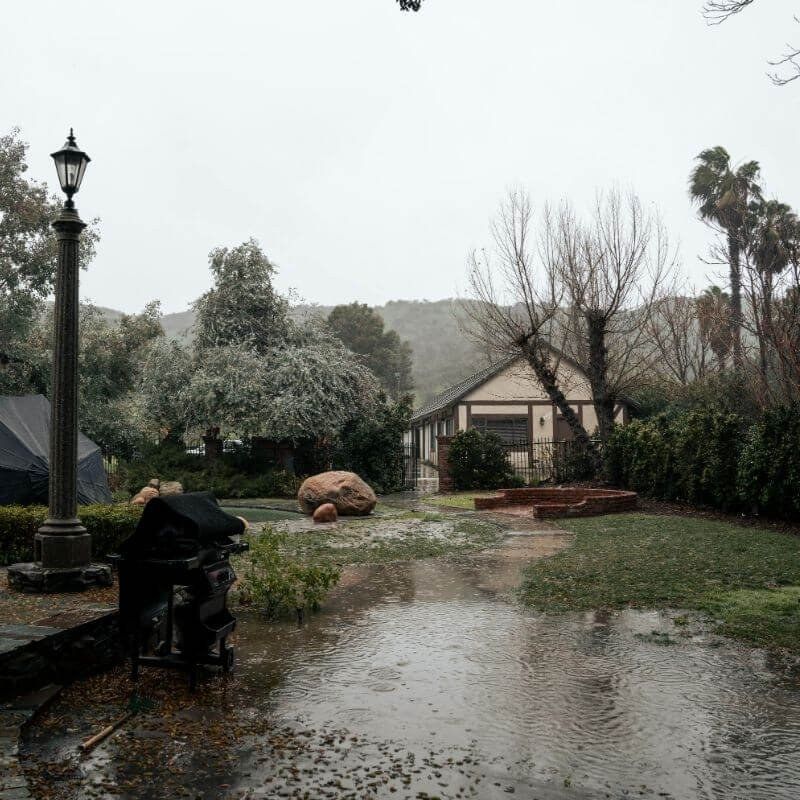
Puddles that sit on the lawn above the soakaway for days, or a soft, boggy patch where the ground used to be firm.
Overflowing gullies
The gully at the foot of a downpipe (the small grated drain it empties into) fills and spills over the paving during rain.
Slow or backed-up downpipes
Gutters overflowing in heavy rain even though they're clear, or water bubbling out of the joint where the downpipe meets the ground.
Damp near the downpipe
A damp patch on an inside wall close to where a downpipe comes down, because water has been pooling against the brickwork outside.
It works in summer but fails in winter
A soakaway that copes in dry months and fills in wet ones may be fighting a rising water table rather than a blockage.
Blocked pipe or blocked soakaway? How to tell
Plenty of soakaways get blamed for a blocked pipe. The pipe between the downpipe and the soakaway can fill with leaves, moss, roof grit and roots, and that's a much cheaper fix. A few checks you can do yourself:
- Is it one downpipe or all of them? If only one gully overflows, the pipe from that downpipe is the likely problem. If every downpipe feeding the same soakaway backs up, the soakaway is the likelier culprit.
- Try a hose on a dry day. Run a garden hose into the gully. A soakaway holds hundreds of litres, so if water backs up within a minute or two, the pipe is the likely blockage. If it takes a long time before backing up, the soakaway is full.
- Lift the cover, if there is one. Some soakaways have an inspection chamber or silt trap with a lid. If the gully is full but the chamber is empty, the pipe between them is blocked. If both are brimming, the soakaway isn't draining.
- Think about the weather. Trouble only after weeks of rain points to groundwater, not a blockage.
Don't climb into or lean over an open chamber, and keep children away from any lifted cover. If the gully itself is the problem, our blocked outside drain page covers that.
How we repair a soakaway
- Check the whole route
We look at gutters, downpipes and gullies, then run a camera along the pipe to the soakaway to see if it's blocked, broken or full of roots.
- Find the soakaway
Old ones are often unmarked. We trace the pipe with a locator and mark the soakaway's position and rough depth.
- Clear and clean
We jet the pipe, empty the silt trap or inspection chamber, and jet through any access points in a crate system.
- Test it
We fill the soakaway with a measured amount of water and watch how fast it drops, so you can see whether it's working again.
- Tell you the result
Fixed, fixed but needs a silt trap, or finished and due for rebuilding. You get the footage and our honest view.
Jetting and silt trap cleaning
Soakaway unblocking is mostly about getting silt out. Drain jetting blasts water at high pressure through the pipe, cutting through leaf mulch, roof grit and small roots, and pushing debris out where it can be removed.
A silt trap is a small chamber on the pipe just before the soakaway. It catches grit and leaves in a bucket or sump you can lift out, so they settle there instead of in the soakaway. If yours has one and it hasn't been emptied for years, that alone can stop the soakaway draining. If it doesn't have one, fitting one is often the cheapest way to make a cleaned soakaway last.
What jetting can reach depends on how the soakaway was built. A modern crate soakaway with access points can be flushed through. An old rubble pit can't: the silt sits between the stones, and no jet will pull it out.
When a soakaway has reached the end of its life
Some soakaways can be brought back. Others are finished, and cleaning them only buys a few weeks. The signs a soakaway is past repair:
- it's an old rubble or brick pit that has silted up solid
- the soil around it has clogged with fine silt, so even an empty pit drains slowly
- the ground above has sunk, or the chamber has collapsed
- roots have filled it
- it's too small for what now drains into it, often after an extension or new patio
- it sits within 5 metres of the house, closer than Approved Document H now allows for new soakaways
Repair or rebuild?
| What we find | Repair | Rebuild |
|---|---|---|
| Leaves, moss or roots in the pipe | Yes, jet and clear | No |
| Silt trap full | Yes, empty it | No |
| Crate soakaway silted, with access | Often, flush it | If silt has clogged the fabric wrap |
| Rubble pit silted solid | Rarely | Usually |
| Collapsed chamber or sunken ground | No | Yes |
| High water table in winter | No | Only if a better spot exists |
| Too close to the house | No | Yes, at least 5 metres away |
If it needs rebuilding, our soakaway installation page explains the soakage test, sizing and rules for a new one.
What soakaway repair costs
- Jetting the pipe and soakawayfrom£150
- Camera survey of the pipe runfrom£150
- Fitting a silt trapFixed quote on the day
- Repairing a broken pipe to the soakawayFixed quote after the camera survey
- Rebuilding or replacing the soakawayfrom£850
What's included in jetting: clearing the gully and pipe, emptying any silt trap, a flow test and our verdict.
What changes the price: how many downpipes feed it, how far the soakaway is from them, whether there's any access, and how much silt has to be taken away.
All prices include VAT. The same price day, night, weekends and bank holidays. See every price on our prices page.
What soakaway repair can and can't fix
It can fix: blocked pipes to the soakaway, full silt traps, a crate soakaway with access that has silted up, a broken gully, and roots in the pipe.
It can't fix:
- a rubble soakaway silted through. The silt is locked between the stones
- saturated ground. If the water table is up, the soakaway has nowhere to empty
- a soakaway that was always too small. Cleaning won't add capacity
- water from somewhere else. A neighbour's run-off, or flooding from a blocked road gully. Road gullies belong to the highway authority (BCP Council, Dorset Council, Hampshire County Council or Southampton City Council, depending on where you are), so report those to them
A soakaway on your land is yours to maintain, and the water company won't clear it. Our guide on when Wessex Water will clear a blocked drain explains what they do and don't cover.
Recent soakaway repair jobs
Soakaways our engineers have cleared, tested or condemned recently.
Real, dated jobs from the job log appear here: town and postcode district, the problem, what was done, and a photo. Nothing shows until real jobs are logged. Service: soakaway-repair.
Our guarantee on soakaway repairs
Our re-block promise covers the pipework we clear to your soakaway. If the same drain blocks again within 30 days, we come back free. We can't guarantee a worn-out soakaway will keep working after cleaning, so if yours is near the end, we'll tell you before you pay for jetting rather than after. The terms are on our guarantee page.
Areas we cover for soakaway repairs
Our engineers work out of Bournemouth, Poole and Christchurch and repair soakaways throughout Dorset and Hampshire.
Soakaway repair FAQs
How do you know if your soakaway is blocked?
The usual signs are gullies overflowing in rain, downpipes backing up, puddles lingering on the lawn above the soakaway, and water taking hours or days to drain away. If only one downpipe is affected, the pipe is more likely blocked than the soakaway. A hose test and a camera survey tell them apart.
How long will a soakaway keep working?
There's no fixed lifespan. It depends on how it was built, how much silt and leaf litter reaches it, and the ground around it. A crate soakaway with a silt trap that gets emptied can last for decades. An old rubble pit with no silt trap may silt up far sooner and can't be cleaned out.
Can a blocked soakaway be unblocked, or does it need replacing?
Often it can be unblocked. If the pipe is blocked or the silt trap is full, jetting and emptying usually sort it. A crate soakaway with access points can be flushed. An old rubble pit silted solid, a collapsed chamber, or saturated ground around it means replacement. We test it before recommending either.
Why is my soakaway not draining after heavy rain?
Either it's too small for the downpour, it's partly silted and has lost capacity, or the water table has risen so the ground around it is already full. If it empties within a day of the rain stopping, it's probably just undersized. If it stays full for days, silt or groundwater is the likelier cause.
What does a soakaway repair cost?
Jetting the pipe and soakaway starts at £150, and a camera survey of the pipe run is from £150. If the soakaway is finished, a rebuild starts at £850. We agree a fixed price before starting, and we won't charge for jetting a soakaway that we can already see is beyond saving.
Who is responsible for a soakaway?
The owner of the land it sits on. A soakaway taking rain from your house is private, so the water company won't clear or repair it. If one soakaway serves several houses, the owners usually share responsibility, and your deeds may say how. Tenants should report a failing soakaway to their landlord.
How can I stop my soakaway silting up again?
Fit a silt trap before the soakaway and empty it at least once a year, more often under trees. Keep gutters clear and add leaf guards or downpipe filters so less debris reaches the pipe. Don't let soil, sand or cement washings from building work go down a rainwater gully.
How do I find my soakaway?
Start at a downpipe and follow the direction the pipe leaves the gully. Soakaways often sit in a lawn or flower bed, sometimes under a sunken or unusually lush patch. Old house plans or a building survey may mark it. If you can't find it, we can trace it with a camera and locator.
Get your soakaway checked
Call 0800 246 5347 or send a photo of the flooded gully or lawn with a callback request. We'll tell you what we think is wrong and what it's likely to cost before we visit.