
Soakaway Installation, Sized From a Proper Soakage Test
Soakaway installation that starts with a test hole in your garden, so the new soakaway is sized for your ground and your roof.
- New soakaways from £850
- Soakage test from £150
- No call-out fee
- 5-year workmanship guarantee on new soakaways
- Most installs take one to three days
When you need a new soakaway
A soakaway is an underground chamber that holds rainwater from your roof or drive and lets it seep slowly into the surrounding ground. You're likely to need a new one if:
- Downpipes empty onto the ground, and the patio floods or water pools against the walls in heavy rain.
- The old soakaway has failed for good. Check it isn't just a blocked pipe first: our soakaway repair page shows how to tell.
- You're adding roof or hard surface, such as an extension, garden room or bigger drive.
- You're paving a front garden. Covering more than 5 square metres between the house and the road needs planning permission unless the surface is porous or the run-off drains to a permeable area on your land, such as a soakaway (General Permitted Development Order 2015, Class F).
- An old soakaway sits right beside the house. A replacement has to meet today's distance rule.
How a soakaway is designed
The soakage test comes first
Every soakaway starts with a percolation test, also called a soakage test. We dig a trial hole to about the depth the soakaway would sit, fill it with water and time how fast the level drops, more than once, because the first fill only wets the ground. Approved Document H says percolation tests should be carried out (paragraph 3.28), and larger soakaways are designed to BRE Digest 365 (paragraph 3.30).
Sizing: how much water, and how fast it leaves
The soakaway has to hold the difference between the rain arriving and the water soaking away. Approved Document H designs for a storm expected once in ten years, and for roofs of 25 square metres or less allows 10mm of rain in five minutes (paragraph 3.27). That's 250 litres down one pipe in five minutes. Fast-draining ground needs a smaller soakaway; slow ground needs a bigger one, or a different answer.
Where a soakaway can go
Approved Document H (paragraph 3.25) says a soakaway should not be built:
- within 5 metres of a building or a road
- in unstable ground
- where the water table reaches the bottom of it at any time of year
- so close to other soakaways that the ground can't cope with both
- where polluted run-off could reach a groundwater source
We also keep clear of trees, boundaries and buried services.
Soakaway crates or a rubble pit
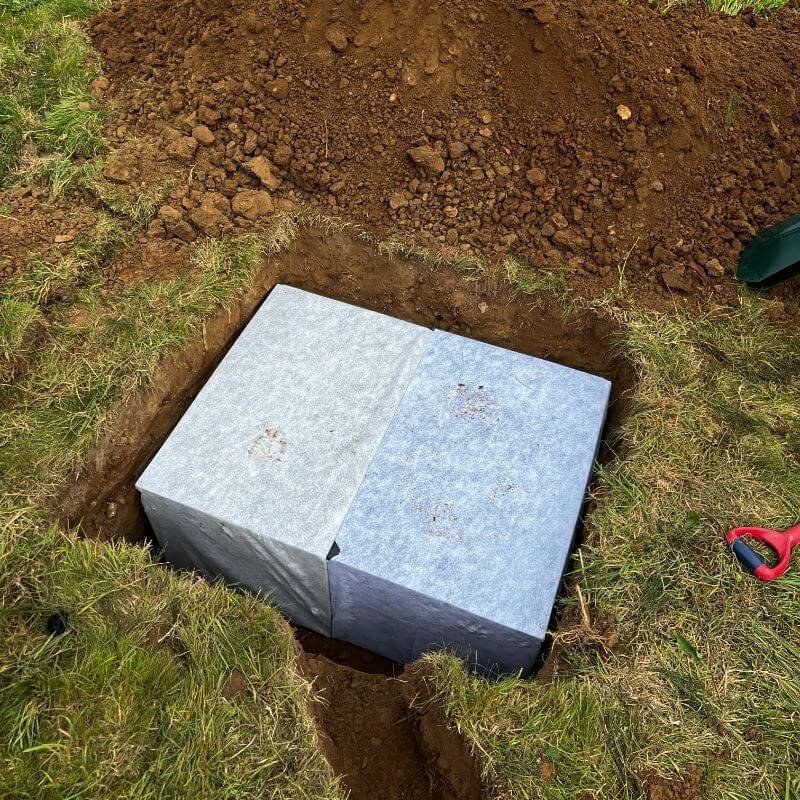
Older soakaways are pits filled with broken brick or stone. Most new ones use soakaway crates: plastic boxes that clip together and are mostly empty space. Manufacturers quote around 95% of a crate as space for water, against roughly 30% for rubble, so the hole can be much smaller. We wrap the crates in geotextile (a tough fabric that lets water out but keeps soil from washing in) and feed them through a silt trap that catches leaves and grit where you can reach them. Rubble still works, but can't be cleaned once it silts up.
Clay soils and high water in Dorset and Hampshire
The ground here changes from street to street. Much of it is free-draining sand and gravel, but the Poole Formation under parts of Poole and Bournemouth contains clay beds, and other parts of Dorset and Hampshire sit on London Clay and similar clays (British Geological Survey). Approved Document H lists clay among the soils that drain poorly, and low-lying ground near rivers and harbours can have a water table that rises in winter. So we test your garden rather than assume.
If the test fails, the options are a longer, shallower trench soakaway, a tank that releases water slowly, or, with permission, a connection to a watercourse or surface water sewer. Approved Document H puts them in order: soakaway where practicable, then watercourse, then sewer (paragraphs 3.2 to 3.4).
How we install a soakaway
- Site visit and soakage test
We measure your roof and paving, mark out the 5 metre line, scan for buried services and run the test.
- Design and fixed price
We size the soakaway from your result, show you where it will go and agree a fixed price before booking the dig.
- Dig and build
We excavate, lay the geotextile, assemble and wrap the crates, and run the inlet pipe through a silt trap with an access cover.
- Inspection before backfill
If Building Control wants to see it before it's buried, we leave it open for the inspector.
- Backfill and hand over
We reinstate turf, gravel or paving, and give you photos and a sketch of its position and depth, which saves time when you sell.
Soakaway cost
- Soakage (percolation) testfrom£150
- New crate soakaway for one downpipe, under a lawnfrom£850
- Larger soakaway, several downpipes, or under a driveFixed quote after the test
- Soakaway replacement in a new positionFixed quote after the test
What's included: digging, crates, geotextile, the silt trap, pipework from the downpipe and reinstating the ground.
What changes the price: the area draining to it, how fast your ground drains, the surface on top, access for a mini digger and the distance from the downpipes.
Building Control charges its own fee, set by the council or approved inspector. We'll tell you whether an application is needed, and what it costs, before you commit. All prices include VAT. Every price we charge is on our prices page.
Soakaway rules: Building Control, SuDS and rainwater only
- Building Control. The government's Planning Portal says building regulations apply to creating a soakaway, which must comply with Part H. Planning permission isn't normally needed for one that takes surface water only, though conservation areas and listed buildings can differ (Planning Portal).
- Rainwater only. Water from sinks, showers, washing machines and toilets is foul water and belongs in the foul drain, never a soakaway.
- Sustainable drainage (SuDS). Letting rain soak in near where it falls is the first choice in the drainage order above. On new homes and larger projects, planning conditions may already set how rainwater is handled, and we build to the approved drawing.
- Your water bill. If all your rainwater goes to a soakaway, not the public sewer, you may be able to claim money off your sewerage charge: Wessex Water's rainwater drainage allowance or Southern Water's surface water rebate.
What a new soakaway can and can't do
A soakaway takes rain from your own roof and paving away from the house. It can't:
- take foul water from a kitchen, bathroom or toilet
- drain ground with a high water table. If groundwater fills the hole in winter, the soakaway fills too
- fit where there isn't room. Some small gardens have no spot 5 metres from every building
- stop water arriving from a neighbour's garden or the road
- fix a blocked gully. Water pooling at the foot of a downpipe is more often a blocked outside drain
A septic tank drainage field is a different system with its own rules. And a soakaway on your land is yours to maintain, not the water company's: our guide on who is responsible for blocked drains explains the split.
Recent soakaway installations
New soakaways our engineers have built lately.
Real, dated jobs from the job log appear here: town and postcode district, the problem, what was done, and a photo. Nothing shows until real jobs are logged. Service: soakaway-installation.
Our guarantee on new soakaways
Each soakaway we build carries our 5-year workmanship guarantee on new soakaways, and the photos taken before backfilling show exactly what's buried. Terms are on our guarantee page.
Areas we cover for soakaway installation
We install soakaways across Dorset and Hampshire. The engineers who build them are based in Bournemouth, Poole and Christchurch.
Soakaway installation FAQs
What is a soakaway and how does it work?
A soakaway is a buried chamber, filled with crates or rubble, that collects rainwater from your roof or drive through a pipe. It stores the water during a downpour and lets it seep slowly into the surrounding soil. It works only where the ground drains well enough, which is why a soakage test comes first.
How much does a soakaway cost in the UK?
Our new soakaways start at £850 for a crate soakaway serving one downpipe under a lawn. Larger soakaways, several downpipes or a site under a driveway cost more, because there's more digging and more to put back. The soakage test is from £150, and you get a fixed price after it.
How far should a soakaway be from a house?
At least 5 metres. Approved Document H says soakaways should not be built within 5 metres of a building or a road, so water soaking into the ground doesn't undermine foundations. The same distance applies to your neighbour's house and garage. On a tight plot, that rule alone can decide whether a soakaway is possible.
How deep should a soakaway be?
There's no single depth in the regulations. The depth comes from the design: how much water it must hold, how fast your ground drains, and where the water table sits, since the base must stay above groundwater all year. The inlet pipe also needs enough fall from the downpipe. The soakage test is dug at the proposed depth.
Do I need building regulations or planning permission for a soakaway?
Building regulations apply to creating a soakaway, which must meet Part H, so Building Control is usually involved. Planning permission isn't normally needed for a soakaway taking surface water only, unless you're in a conservation area or the property is listed. We'll tell you which applies before you commit.
Is a soakaway the same as a septic tank?
No. A rainwater soakaway takes only clean rain from roofs and paving. A septic tank treats sewage from a home that isn't on the mains sewer, then lets the treated liquid out through a drainage field. The two are built to different rules, and sewage must never go into a rainwater soakaway.
Will a soakaway work in clay soil?
Sometimes, but it needs to be much larger, and in heavy clay it may not work at all. Clay lets water through very slowly, so a soakaway can stay full for days. The soakage test gives the answer. If it fails, a trench soakaway, a slow-release tank or a sewer connection with permission are the alternatives.
Can I get money off my water bill with a soakaway?
Possibly. If all the rainwater from your property goes to a soakaway instead of the public sewer, both Wessex Water and Southern Water offer a reduction on the sewerage charge. You apply to your water company and may need to show where the rainwater goes. Photos of the build help.
Book a soakage test
Call 0800 246 5347 or send a photo of where the water collects with a callback request. We'll arrange the test and give you a fixed price for the soakaway.