
CCTV drain survey: see what's wrong inside the pipe before anyone digs
A CCTV drain survey sends a camera through your pipes, so you see the actual fault before paying for any repair.
- Surveys from £150
- No call-out fee
- Booked at a fixed price agreed before any work starts
- We show you the camera footage before we leave
- Report within 48 hours
When a drain survey is worth booking
A camera survey earns its cost when something is wrong and nobody can say what. The usual reasons:
- The same drain keeps blocking, however often it's cleared.
- Someone has told you the drain needs digging up, and you want to see the evidence first.
- A damp patch, a sunken area of lawn or drive, or a smell with no obvious source.
- Rats in the house or garden. A broken drain is a common way in.
- You're planning an extension near a drain, or the water company has asked about building over one.
- Your insurer wants proof of damage before accepting a claim.
- You're buying a home. Our homebuyer drain survey is built around the purchase, with a report written for that decision.
What a drain camera inspection finds
These are the defects the camera finds most often, in the words you'll see in a report.
- Cracks and fractures. Lines along or around the pipe. A crack lets water out and roots in. A fracture is a crack that has opened up.
- Displaced joints. Two lengths of pipe that have shifted out of line, leaving a lip that catches waste. Common in older clay drains.
- Root ingress. Roots growing in through a joint, from a few hair-like strands to a mat that fills the pipe.
- Fat and scale. Grease or hard deposits narrowing the pipe from the inside.
- Deformation. A pipe squashed out of round by the weight of soil or traffic above it.
- Pitch fibre blistering. Bubbles and flaking inside pitch fibre pipes, which were laid from the 1950s to the 1970s. It's an early sign the pipe is breaking down.
- Standing water. A dip in the pipe, called a sag or belly, where waste settles instead of flowing.
- Collapse. Part of the pipe has fallen in. The camera often can't get past it.
Push rod camera or crawler: which one your drains need
Push rod camera
A camera head on a stiff but flexible rod, pushed by hand from a manhole or gully. It bends round the tight corners in household drains and suits most domestic pipes, which are usually 100mm or 150mm across. The picture stays upright as the head turns, and a counter records how far along each defect sits.
Crawler camera
A small motorised vehicle carrying the camera, steered from the surface. It suits larger, longer, straighter pipes such as sewers and commercial drains, where a pushed rod would run out of reach.
Tracing the pipe from above
Most camera heads carry a sonde, a small radio transmitter. With a locator on the surface, the engineer can mark on the ground exactly where a defect is and how deep it lies. Any repair then digs in the right place, or doesn't dig at all.
How a CCTV drain survey works
- Book and agree the price
Tell us why you want the survey and how many manhole covers you can see. You get a fixed price before we book.
- Clean the pipe if needed
A pipe coated in fat or silt hides its defects, so we jet that section first. We'll ask before we do.
- Run the camera
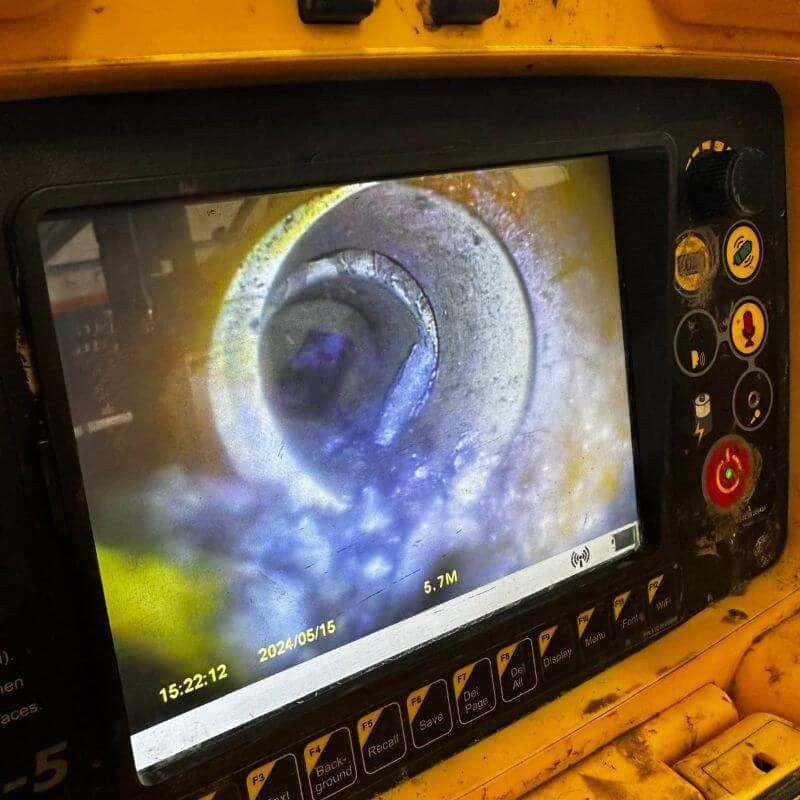
The engineer surveys each run between access points, recording the footage and logging distances.
- Watch it together
We show you the camera footage before we leave, and talk you through anything that matters before packing up.
- Receive the report
Your drain survey report arrives within 48 hours, with the recorded footage.
What the drain survey report contains
- A sketch plan of your drains, showing each manhole, the runs between them and which way they flow.
- For every run: the pipe material, its diameter, its length and the direction the camera travelled.
- Each observation logged at its distance from the start point, with a still image.
- A code and grade for every defect, explained in plain English.
- A summary of what needs doing now, what to keep an eye on and what can be left alone.
How defects are graded
Professional drain surveys code what the camera sees using MSCC5, the Manual of Sewer Condition Classification (fifth edition), published by WRc. Each defect gets a grade from 1 to 5.
| Grade | What it means | Usual next step |
|---|---|---|
| 1 | Very minor, no real effect on the pipe | Nothing |
| 2 | Minor defect or early wear | Keep an eye on it |
| 3 | Moderate defect | Plan a repair |
| 4 | Serious defect, likely to get worse | Repair soon |
| 5 | Severe: collapsed or close to it | Repair now |
Structural defects (damage to the pipe itself) and service defects (things inside it, such as roots or fat) are graded separately, because a pipe can be sound but dirty, or clean but cracked.
CCTV drain survey cost
- Camera inspection of one run, such as a gully to the first manholefrom£150
- Full survey of a typical house, all accessible runs, written report£150 to £350
- Homebuyer drain survey, report written for your purchasefrom£195
- Jetting a dirty pipe so the camera can seefrom£150
Included: the camera work, footage shown on site, and the report with stills and grades. What changes the price: how many manholes and runs there are, the length of pipe, whether jetting is needed first, whether you want the route and depth marked on the ground, and access to covers under decking or paving. All prices include VAT. The same price day, night, weekends and bank holidays. See every price on our prices page, or our guide to what a CCTV drain survey costs for UK prices by survey type.
What a CCTV drain survey can and can't tell you
What it can't do
- It can't fix anything. A survey is a diagnosis. The cure is a clean, a drain repair or drain relining, and the footage shows which.
- It can't see past a blockage or a collapse. We clear the blockage first, or survey from the other end.
- It can't reach pipes with no way in. If a run has no manhole, gully or rodding point, the report will say so.
- It doesn't pressure test. A camera shows defects, not whether a pipe holds water under pressure. That's a separate test.
When you don't need a survey
- One blockage that cleared easily and hasn't come back. Get it unblocked and carry on.
- A single slow sink or bath. The camera goes into the underground drain, not the pipe under your sink.
- A blockage in the public sewer. The water company surveys its own pipes.
- A recent survey already exists and nothing has changed since. Ask for a copy first.
Recent drain surveys
Surveys we've carried out recently, and what the camera turned up.
Real, dated jobs from the job log appear here: town and postcode district, the problem, what was done, and a photo. Nothing shows until real jobs are logged. Service: cctv-drain-survey.
What we promise on every survey
We show you the camera footage before we leave. Your written report follows within 48 hours. If the survey leads to a repair or relining with us, that work comes with our 10-year guarantee on relining and repairs. Read the terms on our guarantee page.
Areas we cover for drain surveys
Our engineers are based in Bournemouth, Poole and Christchurch and survey drains throughout Dorset and Hampshire.
CCTV drain survey FAQs
What is a CCTV drain survey?
A CCTV drain survey is an inspection of your underground drains with a waterproof camera, fed through the pipes from a manhole or gully. The engineer records the footage, notes where every defect is and writes a report grading the pipe's condition. It finds the cause of a problem without digging anything up.
How much is a CCTV drain survey in the UK?
Our CCTV drain surveys start from £150, and most houses fall in the £150 to £350 range with a written report. The price depends on how many runs there are, how long they are and whether the pipe needs cleaning first. You'll have a fixed price before you book, with VAT shown.
How long does a drain survey take on site?
On site, a survey of a typical house takes 1 to 2 hours for a typical house. Larger properties, long runs or pipes that need jetting first take longer. You see the footage before the engineer leaves, so you'll know the main findings the same day, and the written report follows within 48 hours.
What does a drain survey show?
A drain survey shows the inside condition of every pipe the camera can reach: cracks, fractures, displaced joints, roots, fat, scale, deformation and collapse. It also shows which way the pipes run, how deep they are and where they join. That matters if you're planning to build near them or need to show damage to an insurer.
Does someone have to be home for the survey?
Usually, or someone does. The engineer needs to reach the manholes and gullies, and often needs to run taps and flush toilets inside so the camera can follow the water. If you can't be there, a neighbour, tenant or agent with keys can let us in, and we'll talk you through the footage by phone.
Can a drain survey find where rats are getting in?
Often, yes. Rats live in sewers and get into homes and gardens through broken pipes, open joints and old connections that were never sealed off. A camera survey traces those gaps so they can be repaired. A one-way rat flap can also be fitted in a manhole to stop them coming back up the drain.
Is a drain survey needed for an extension or build over agreement?
Often, yes. Building over a public sewer, or close to one (usually within 3 metres), needs the water company's permission first, and Wessex Water, for example, carries out its own CCTV survey as part of that process. Surveying your own drains beforehand shows where they run and their condition, so the design can allow for them.
Can you survey a drain that's blocked?
Not beyond the blockage, because the camera needs clear pipe to travel along. We can survey up to the blockage to see what's causing it, clear it, then survey the rest. That's often the most useful survey of all: you see exactly what caused the blockage before deciding whether a repair is worth paying for.
Want to see inside your drains?
Get a fixed price for your drain
Call 0800 246 5347 or request a callback with the reason for the survey, and we'll quote a fixed price and the first date we can do.