
Homebuyer drain survey: know what's under the garden before you exchange
A homebuyer drain survey puts a camera through the drains of the house you're buying, so a hidden repair bill doesn't become yours.
- Homebuyer surveys from £195
- No call-out fee
- You'll have a fixed price agreed before any work starts
- Usually booked within 3 working days
- Report and footage within 48 hours
Why your house survey won't tell you about the drains
Your mortgage valuation isn't a survey at all. It's for the lender, to check the house is worth the loan.
A RICS Home Survey Level 2 (what used to be called the HomeBuyer Report) goes further, but it's still a visual inspection. RICS's own description says the surveyor may lift accessible inspection chamber covers and look inside where it's safe to. It also says drainage isn't tested and the drainage installation isn't investigated. A Level 3 building survey is more thorough, but it doesn't put a camera down the pipes either.
So the part that actually fails, the pipe between the chambers, is the part nobody sees. If your surveyor spots a warning sign, the report will usually suggest a specialist drain survey.
Your conveyancer's drainage and water search (the CON29DW) answers different questions: whether the house connects to the public sewer, whether a public sewer is shown inside the boundary, and whether building near one was approved. It says nothing about the pipes' condition.
Which homes most need a pre purchase drain survey
Any house can have a broken drain, but these are the ones we'd never skip.
Older houses
Victorian, Edwardian and interwar homes mostly have clay drains with rigid joints. A century of ground movement opens those joints and cracks the pipes.
Homes with trees nearby
Roots find the smallest gap. A mature tree or big hedge near the drain run is a classic cause of cracked pipes, and the damage is invisible from the garden.
Houses built from the 1950s to the 1970s
Many homes of this era were laid with pitch fibre drains, made from wood fibre soaked in tar pitch. They were light and cheap to lay, but with age they soften, blister inside and sag out of round. A pitch fibre drain in poor condition usually needs relining, and the survey tells you how much of it.
Extensions and conservatories
If a previous owner built over or near a drain, check two things: that the pipe underneath is still sound, and, if it's a public sewer, that the water company agreed to the work. The survey answers the first. Your conveyancer's search helps with the second.
Shared drains
Terraced and semi-detached houses often share a drain run. Since October 2011, most pipes serving two or more homes have been public sewers, which the water company maintains. That's good news for repair bills, but it matters if you plan to extend, because building over or close to a public sewer needs the water company's consent. Our guide to who is responsible for blocked drains explains where your pipe ends and theirs begins.
When to book a drain survey before buying a house
Book it as soon as your offer is accepted, alongside your building survey, and well before exchange of contracts. Until you exchange, you can renegotiate or pull out. Once you've exchanged, you're legally committed, and any drain problem comes with the house.
- Offer accepted
Send us the address and the estate agent's details. Surveys are usually booked within 3 working days.
- Access arranged
We agree a time with the agent and the seller.
- Survey day
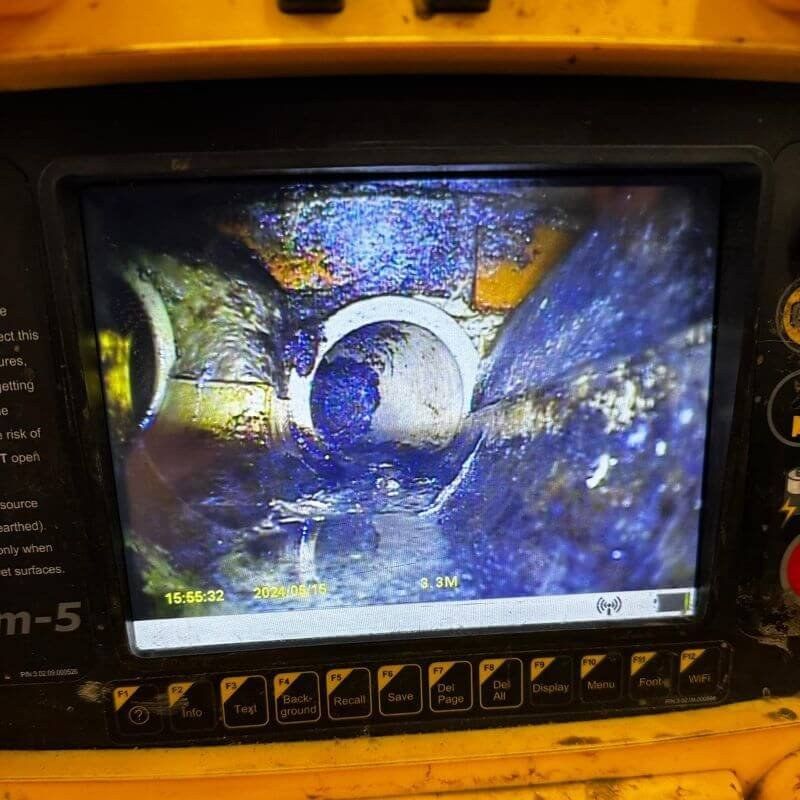
The engineer lifts the covers, runs the camera through each accessible run and flushes the fittings to follow the flow. Come along if you can: We show you the camera footage before we leave.
- Report
The written report and footage reach you within 48 hours. Forward them straight to your conveyancer.
- Decide
Carry on, renegotiate, or ask for repairs before you exchange.
Getting the seller's permission
The drains belong to the seller until completion, so we need their agreement. Ask the estate agent to arrange it, and mention that we'll lift the manhole covers and run the taps and toilets. If covers are painted shut or hidden under decking or gravel, ask the seller to uncover them, or warn us so we come prepared.
What the homebuyer CCTV drain survey report tells you
The report is written for someone making a decision. It opens with the questions you actually have: are the drains sound, what's wrong if not, how urgent it is, and what kind of work would put it right. Behind that sits the detail: a plan of the runs, each defect graded and located, stills and the footage. For how defects are coded and graded, see our CCTV drain survey page.
Using the survey to renegotiate the price
If the camera turns up a problem, you have choices, and you have them before exchange.
- Ask for a price reduction that covers the repair. A fixed repair quote carries more weight than a rough guess, so ask us to price the work.
- Ask the seller to repair it before completion, with proof the work is done, such as follow-up footage.
- Agree a retention, where part of the price is held back until repairs are finished. Your conveyancer will check whether your lender allows it.
- Walk away, if the repair is more than the house is worth to you.
- Check who is responsible first. If the fault is in a shared pipe that's now a public sewer, the water company fixes it, not you or the seller.
For scale: a single patch repair starts from £250, and drain relining is typically £80 to £150 per metre. A collapsed drain repair that needs digging costs more.
Homebuyer drain survey cost
- Typical house, all accessible runs, report and footagefrom£195
- Larger or older property, several runs or a long driveFixed quote before you book
- Pipe too dirty for the camera, jetted firstfrom£150
Included: the camera survey, the written report and the footage. What changes the price: the number of manholes and runs, how long they are, and whether a pipe needs cleaning before the camera can see. All prices include VAT. The same price day, night, weekends and bank holidays. Our full price list and our guide to CCTV drain survey costs compare survey types.
What a homebuyer drain survey can and can't tell you
- It can: show the condition of every run the camera reaches, locate each defect, and show which pipes are shared and where they run near an extension.
- It can't: promise the drains will stay sound after you move in. It covers what the camera can reach, and any run without an access point is named in the report.
- It doesn't cover: off-mains systems such as septic tanks and treatment plants, which need their own inspection, or the clean water supply pipe.
- It isn't a legal search: whether an extension had the water company's consent is for your conveyancer to confirm.
Recent homebuyer surveys
A few of the pre-purchase surveys we've done lately, and what buyers did next.
Real, dated jobs from the job log appear here: town and postcode district, the problem, what was done, and a photo. Nothing shows until real jobs are logged. Service: homebuyer-drain-survey.
What we promise on every homebuyer survey
Your report arrives within 48 hours of the survey. If you buy the house and we carry out a repair the survey found, that work comes with our 10-year guarantee on relining and repairs. The details are on our guarantee page.
Homebuyer drain survey FAQs
Do I need a drain survey when buying a house?
It isn't a legal requirement, and your lender won't normally insist on one. But a standard house survey doesn't test the drains, so a camera survey is the only way to see their condition before you commit. It's most worthwhile for older homes, houses near trees, 1950s to 1970s builds and homes with extensions.
Is a drain survey worth it?
For most older homes, yes. The survey costs from £195, while relining a damaged drain runs at £80 to £150 per metre, and digging out a collapsed pipe costs more. Finding that before exchange lets you negotiate the repair off the price. If the drains are fine, you've paid for proof they're fine.
Does a house survey check drains?
Only from the surface. At RICS Level 2 the surveyor may lift accessible inspection chamber covers and look into the chambers where it's safe, but doesn't test the drains or see the pipes running between them. If there are signs of trouble, the report will usually suggest a specialist drain survey. A mortgage valuation doesn't look at drains at all.
How much does a homebuyer drain survey cost?
Our homebuyer drain survey starts from £195 for a typical house, including the written report and footage. Larger homes, long drain runs, or pipes that need jetting before the camera can see cost more. You'll have a fixed price before you book, and we'll ask before adding anything on the day.
Who pays for a drain survey when buying a house?
The buyer usually pays, because the survey is for your benefit and the report is addressed to you. Some buyers ask the seller to share the cost, or to pay for repairs the survey finds. If the seller already has a recent survey, ask to see it, and check it covers every run.
When should I get a drain survey when buying a house?
As soon as your offer is accepted, alongside your building survey. That leaves time for the seller to agree access, for the report to arrive and for any renegotiation, all before exchange of contracts. Once you exchange, you're committed to buy, so a problem found afterwards is yours to pay for.
Do I need the seller's permission for a drain survey?
Yes. Until completion the house is theirs, so the survey needs the seller's agreement and access to the manholes, gullies, taps and toilets. The estate agent normally arranges it. If the seller refuses, your conveyancer can raise it as a pre-contract enquiry and ask what they know about the drains.
What is a pitch fibre pipe?
Pitch fibre is a drain pipe made from wood fibre soaked in coal tar pitch, laid under many British homes from the 1950s to the 1970s. It was light and cheap, but it softens with age, blisters inside and can squash into an oval. A camera survey shows how far that has gone and whether relining is needed.
What is a build over agreement?
It's the water company's written permission to build over, or close to, a public sewer. It protects the pipe and the company's right to reach it. If the house you're buying has an extension near a sewer, your conveyancer should check one was granted, because the drainage search asks the water company exactly that.
Buying a house with older drains?
Get a fixed price for your drain
Call 0800 246 5347 or request a callback with the address and your exchange date, and we'll fix a price and a survey slot that fits.