
What are the signs of a collapsed drain?
The short answer: the usual signs of a collapsed drain are the same drain blocking again and again, water backing up or draining slowly, a sewage smell outside, sinking ground over the pipe, damp patches near a drain run, and rats. One sign alone may just be a blockage. Two or more together call for a camera survey.
A collapsed drain rarely fails all at once. A crack opens, a joint drops, soil starts to wash in, and the signs of a collapsed drain build over weeks or months. Most people first notice a drain that keeps blocking, or a patch of paving that has started to sink. This guide lists the symptoms, what each one might mean and how quickly to act, then covers causes, insurance and repair.
Collapsed drain symptoms: a checklist
| Sign | What it might mean | How urgent |
|---|---|---|
| The same drain blocks again within weeks | A partial collapse, a dropped joint or roots catching waste | Soon. Get a camera survey rather than paying to clear it again |
| Water or sewage backing up out of a gully or manhole | Waste can't get past a collapse further down | Urgent. Stop using water and get help today |
| Sinks, bath and toilet all draining slowly or gurgling | A restriction in the underground pipe they share | Soon |
| A sewage smell outside with no blockage you can see | Foul water leaking from a broken pipe into the ground | Soon. Urgent if the smell is indoors |
| A dip, sinking paving or a cracked drive along the drain line | Soil washing into a broken pipe, leaving a hollow | Urgent. Keep people and cars off it |
| A hole opening up in a lawn or drive | A void above a collapse | Urgent. Fence it off and get it seen the same day |
| Damp patches or mould low on walls or floors near a drain | A leaking pipe close to or under the house | Soon |
| New cracks in walls, or doors and windows starting to stick | Possible ground movement, sometimes from a leaking drain | Urgent to investigate. Tell your insurer |
| Rats in the garden or indoors | A break giving them a route out of the sewer | Soon. Deal with the rats and the route in |
| A strip of grass greener than the rest | Leaking foul water feeding the grass | Worth checking |
| Soil, stones or roots in the bottom of a manhole | The pipe is broken somewhere upstream | Soon |
What does a collapsed drain look like?
From above ground, often nothing at all. When there are visible signs, they follow the line of the pipe: a shallow dip in the lawn, a row of paving slabs sitting lower than the rest, or a crack across a drive that lines up with a manhole.
Lift a manhole cover on your own land, if it's safe to, and look at the channel in the bottom. In a healthy chamber, water runs through and the channel is clear. Standing water, silt, stones or root fibres suggest trouble in the pipe feeding it.
On a camera survey, a collapse looks like pipe that has lost its shape: a round pipe squashed into an oval, a section with pieces missing and soil showing through, joints stepped out of line, or roots pushing through a joint until the camera can't pass. Pitch fibre pipes, a tar-soaked fibre popular from the 1950s to the 1970s, tend to blister and flatten rather than crack.
Can a blocked or broken drain cause damp?
Yes, when the blocked pipe is also leaking. A sound pipe that blocks simply backs up. A cracked pipe that blocks is different: the waste water building up behind the blockage is pushed out through every crack and open joint, into the ground beside your walls. Brickwork and floors soak it up.
Signs include tide marks low on a wall, a musty smell, peeling paint or mould near where a drain runs, or damp under a suspended timber floor. A blocked gully that overflows against an outside wall can also soak the brickwork above the damp proof course.
Damp has plenty of other causes, from gutters to condensation. A camera survey of the nearby drain rules it in or out quickly.
Can a collapsed drain cause subsidence?
It can. The Financial Ombudsman Service explains that a significant or long-running escape of water, from leaking pipes for example, can wash away the fine particles in the soil under a house, or soften the soil so it can't carry the weight. Either way, the foundations can sink. That's why insurers usually include a CCTV inspection of drains near the house when they investigate subsidence.
This matters around Bournemouth and Poole, where a lot of homes sit on sandy ground (the British Geological Survey maps sands such as the Branksome Sand across the area). Sand is carried away by leaking water more readily than clay. A blocked drain on its own rarely causes subsidence. The risk comes when a blocked pipe is also broken.
Rats and broken drains
Rats live in sewers and follow the pipes. A crack, a joint that has pulled apart, or an old pipe left open when a kitchen or bathroom was moved gives them a way into your garden, under your floors or into wall cavities. Southern Water says damage or defects in the network make it easier for rats to move between the sewer and the surface.
Pest control deals with the rats, but they come back unless the route is closed. A camera survey finds the break, and a repair, or a one-way rat flap fitted in a manhole, shuts it.
What causes drains to collapse?
- Age. Older clay pipes have rigid joints that crack and shift as the ground moves over the decades.
- Pitch fibre pipes. Common in homes built from the 1950s to the 1970s, they soften, blister and deform with age.
- Tree and shrub roots. Roots find moisture at a joint, squeeze in and widen the gap until the pipe breaks.
- Ground movement. Clay soils shrink in dry summers and swell in wet winters (the British Geological Survey explains how), which puts stress on rigid pipes.
- Soil washing away. A small leak in sandy ground can wash out the support around a pipe, until the pipe sags and breaks.
- Weight. Cars, vans, skips and diggers parked over shallow pipes crush them over time.
- Building work. Extensions, fence posts, new drives and landscaping can crack or disturb pipes, sometimes without anyone noticing.
- Poor earlier repairs. A badly made joint or a mismatched connection becomes the weak point.
What to do if you think your drain has collapsed
- Ease off the water
Fewer flushes, and no washing machine, dishwasher or long showers until you know what's wrong.
- Make the area safe
Keep children, pets and vehicles off any dip or hole, and put something solid around it.
- Work out whose pipe it is
If the damaged section is shared, or sits past your boundary, the water company normally repairs it at no cost to you. If you rent, tell your landlord. Our guide on who is responsible for blocked drains explains the rules.
- Tell your insurer before any repair
Most policies say you shouldn't carry out repairs until they've inspected. If something can't wait, keep photos, a detailed report and an itemised invoice.
- Get a camera survey
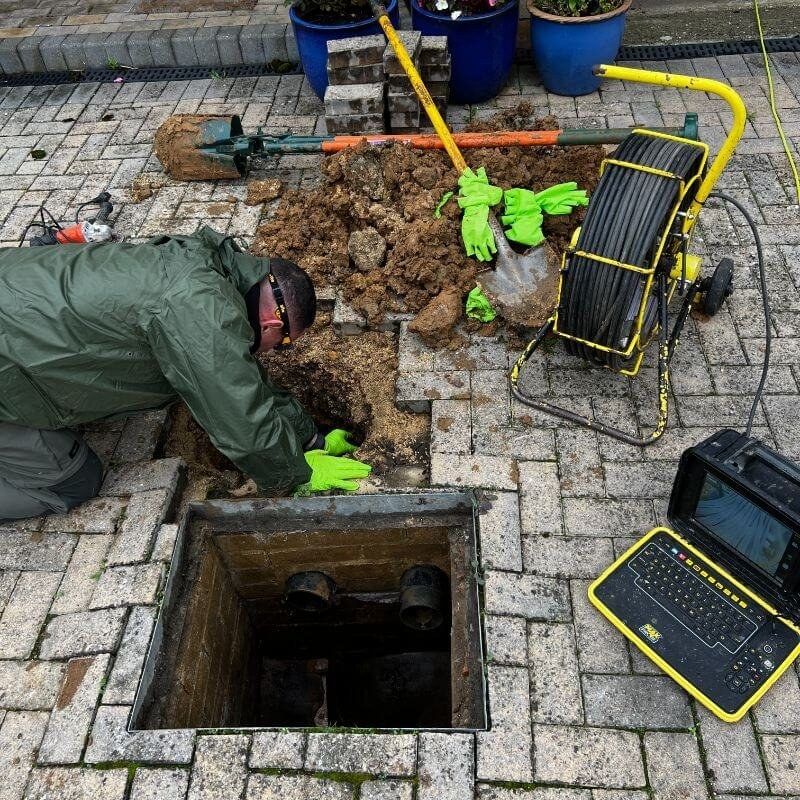
A CCTV drain survey shows where the damage is, how bad it is and how long the damaged section is.
- Get a fixed price for the repair
The survey tells you which repair fits, so you're not paying for more than the pipe needs.
Two things to avoid. Chemical drain cleaners don't fix a broken pipe and make the water hazardous for whoever deals with it. And paying for the same drain to be jetted again and again treats the symptom, not the break, and hard jetting at a collapse can draw more soil into the pipe.
Is a collapsed drain covered by insurance?
Often, but not always. The Financial Ombudsman Service says most buildings policies cover damage to underground pipes you're legally responsible for. It lists the reasons insurers most often give for turning claims down:
- the pipe wasn't damaged, or wasn't damaged accidentally
- the damage was gradual, or wear and tear
- the pipe was made of pitch fibre
- the pipe isn't yours
- it was repaired before the insurer could inspect it
- the policy has no cover for underground pipes
Cover usually pays for the pipe itself. Damage to the house from a leak may fall under the escape of water section of your policy instead, and the Ombudsman notes that subsidence caused by escaping water is usually looked at under that section first, which often means a lower excess. If the insurer has to dig to reach the pipe, the Ombudsman would normally expect it to put your drive or patio right even if it rejects the claim.
If you rent, the landlord's buildings insurance applies, not your contents cover. If you're unhappy with an insurer's decision, complain to the insurer first. After eight weeks, or once you have its final response, you can take it to the Ombudsman for free.
What a collapsed drain costs to fix
It depends on the damage, which is why the survey comes first. MyJobQuote's collapsed drain repair costs, updated 27 August 2026, put a typical repair at about £850:
| Repair | When it fits | Typical 2026 price |
|---|---|---|
| Patch repair | One crack or a displaced joint | £150 to £300 |
| Relining (no dig) | Cracks, open joints or roots along a run that still holds its shape | £80 to £150 per metre |
| Dig and replace | A section that has lost its shape, has pieces missing or sags | £250 to £650 per metre |
| Under a drive or extension | Extra breaking out and making good | Adds £500 to £2,000 |
Our collapsed drain repair starts with a survey and a fixed quote. Patch repairs start from £250 and drain relining costs £80 to £150 per metre. We give a 10-year guarantee on relining and repairs. All prices include VAT.
When to call an engineer
Call the same day if:
- sewage is coming up through a gully, manhole or toilet
- a hole or a fresh dip has appeared over a drain
- new cracks have appeared in walls, or doors have started to stick
Book a survey this week if a drain has blocked more than once in a few months, you can smell sewage outside, or you've seen rats. Call 0800 246 5347 or send a photo of the dip or the open manhole with a callback request. If the damage looks like it's on the water company's pipe, we'll tell you, so you can report it and get it fixed free.
The engineer who wrote or checked this guide, with their role and the date it was reviewed.
Collapsed drains: common questions
How long can you leave a collapsed drain?
Not long. A collapse gets worse as soil washes in and waste washes out, and a partial collapse can block completely without warning. Once you see sinking ground, sewage backing up or cracks in walls, get it looked at within days, not months. Leaving it can also give an insurer grounds to call the damage gradual.
Can I still use the toilet if my drain has collapsed?
If water still drains away, use it sparingly and hold off on the washing machine, dishwasher and baths. If anything is backing up, stop using water altogether, because every flush adds to what has to come back out. If the collapse is in the public sewer, report it to the water company.
Who pays to fix a collapsed drain?
You pay if the damaged pipe serves only your home and sits inside your boundary, though buildings insurance may cover it. The water company pays if the pipe is shared or lies beyond your boundary. In a rented home it's the landlord. On a newer estate with unadopted sewers, it may be the developer or management company.
Can a collapsed drain be relined instead of dug up?
Sometimes. Relining works when the pipe still holds its shape, even if it's cracked, has open joints or has had roots in it. Where a section has lost its shape, has pieces missing or has sagged into a dip, it usually has to be dug up and replaced. The camera survey decides which.
Does a collapsed drain always smell?
No. Some collapses smell strongly, because foul water is leaking into the ground. Others give no smell at all and only show up as repeat blockages, a dip in the ground or a slow drain. A missing smell doesn't mean the pipe is sound.
Can tree roots break a drain?
Yes. Roots are drawn to the moisture at a pipe joint, squeeze in through tiny gaps and then thicken, widening the gap until the pipe cracks. The mat of roots inside also catches paper and fat, which is why root damage often shows up first as repeat blockages.